In today’s always-connected world, fast and reliable internet is no longer a luxury; it’s an essential utility. For community associations, investing in a fiber-optic network is one of the most impactful decisions a board can make. But with multiple vendors offering competing proposals, how can you ensure your making a true apples-to-apples comparison?
Not all fiber internet services are created equal. For a connection to be considered true Fiber-to-the-Home/Unit (FTTH/U), the fiber must run directly from the source all the way to each individual unit. To properly assess this, understanding the construction methods and network configuration behind each proposal is critical.
Providers often differ significantly in their use of technical language, service packages, and pricing structures, making it easy to miss key differences that affect long-term value. Choosing one based on price alone may seem fiscally responsible in the short term but can result in performance issues, resident complaints, and expensive upgrades later.
Here’s how you can create a strategic framework to help your board evaluate fiber-optic proposals side by side, to make informed, confident decisions that will benefit your community for years to come.
What to Compare: Seven Core Categories
1. Network Infrastructure & Technology
Start with the fundamentals: What is the provider actually delivering? True fiber-to-the-home/unit (FTTH/U) means the fiber-optic connection runs directly into each residence, offering the fastest, most reliable service. In contrast, some providers use fiber only to a central node or curb, finishing the connection with outdated copper or coaxial cables that can create potential bottlenecks.
Boards should also ask about the type of fiber technology used. GPON (Gigabit Passive Optical Network) is common but often shared across multiple units. XGS-PON, a newer standard, supports higher symmetrical speeds and better scalability.
Ask the following questions:
- “What’s the last-mile technology?”
- “Is each unit receiving a dedicated fiber connection?”
2. Symmetrical Speeds & Scalability
Download speed is often the headline number, but upload speed is just as critical, especially with video conferencing, cloud storage, and smart home devices becoming commonplace.
Symmetrical speeds (e.g., 1 Gbps down and 1 Gbps up) provide a smoother experience than asymmetrical ones (e.g., 1 Gbps down, 100 Mbps up). Boards should also consider whether the network can scale to 2 Gbps or even 10 Gbps without significant infrastructure upgrades.
Providers should clearly outline current speed tiers and their roadmap for future upgrades.
Questions to ask include these:
- What is the maximum speed you can offer (1G/10G/50G)?
- Are speeds symmetrical?
- If your ceiling is 1G today, what do you need to change to offer 10G?
3. Equipment & In-Unit Installation
A fiber network is only as good as its delivery point inside the home. Pay close attention to the customer premises equipment (CPE) included in the proposal.
Key questions to ask:
- How many WiFi access points are included?
- Is the network professionally managed or simply basic hardware?
- Is installation handled by technicians, or is it self-install?
These details directly impact resident satisfaction and can reduce the volume of service calls.
4. Service Level Agreements (SLAs)
SLAs define the performance standards the provider is contractually obligated to meet. This is where strong partners separate themselves from the rest.
Look for the following:
- Uptime guarantees
- Guaranteed response and resolution times
- Proactive monitoring and outage notifications
Also ask whether service credits are issued for missed SLAs. Providers who offer this show a real commitment to accountability.
5. Support & Customer Experience
Even the best technology can fail if support is subpar. Associations should evaluate the provider’s customer service experience.
The following are considerations:
- Is there a dedicated support line for the community?
- Are customer service reps local or overseas?
- What are average wait times and first-response rates?
Support is more than fixing problems, it’s about trust and peace of mind.
6. Bulk Pricing & Contract Terms
Price matters but only in the context of what’s included. Ask the following:
- Does the price include equipment, installation, and maintenance?
- Are there hidden fees or annual escalators?
- What is the contract length, and are there renewal options?
Boards should evaluate the total cost of ownership, not just the monthly per-unit price. A seemingly cheaper provider may cost more in the long run due to poor performance or lack of support.
7. Added Value & Future-Proofing
Some providers offer additional features that enhance value and readiness for the future, such as these benefits:
- Bundled streaming, voice, or security services
- Community-wide WiFi in common areas
- Resident dashboards or usage reports
- Ongoing infrastructure upgrade plans
- Seasonal pause plans for snowbird communities
Ask how the provider plans to support future needs, like WIFI7, 50G-PON, smart buildings, or energy-efficient technology upgrades without major reinvestments.
Standardizing Bid Comparison
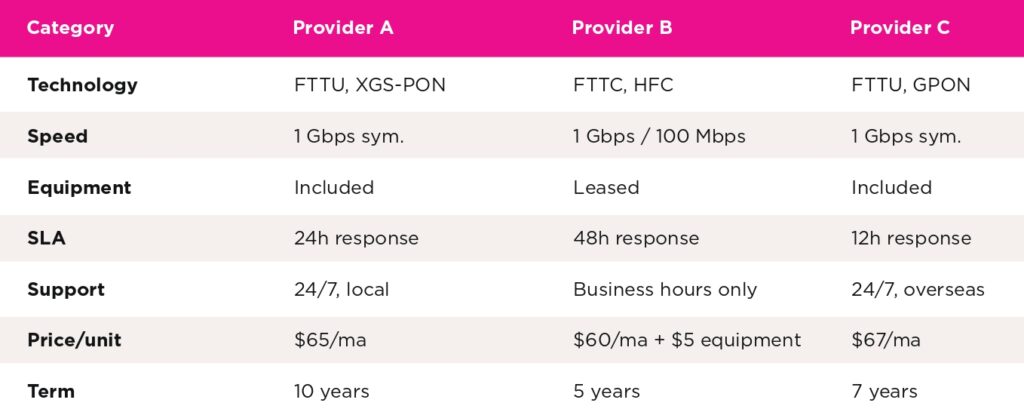
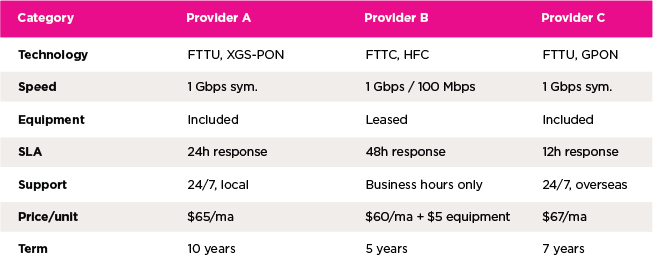
To make a true apples-to-apples comparison, boards should develop a bid checklist using the categories above. Require all vendors to complete this checklist during the RFP (Request for Proposal) process to help remove ambiguity, highlight differences, and clearly identify the proposal that delivers the most value for the contract. (see example chart)
Common Pitfalls to Avoid
Even with a solid framework, boards can fall into the following common traps:
- Focusing only on price, without understanding what’s included
- Assuming all fiber networks are built the same
- Ignoring support structures and SLAs
- Not to gathering resident input on pain points and expectations
Boards can avoid these missteps by asking the right questions and expecting detailed answers.
Fiber as a Long-Term Investment
Fiber is more than a utility, it’s infrastructure that defines the digital experience of your community. Making decisions based on long-term value rather than short-term cost ensures that residents enjoy fast, reliable internet now and are ready for the technologies of tomorrow.
By applying a clear, consistent approach to comparing bids, community associations can protect their investment, increase resident satisfaction, and build lasting partnerships with fiber internet providers who are committed to future-ready solutions.
If your board is preparing to evaluate internet bulk proposals, start by creating a comparison checklist similar to the one above. We offer complimentary consultation sessions and can help guide you through the process. A well-informed decision today leads to a better-connected, future-proof community tomorrow. Reach out for more information: sales@fibernow.com.